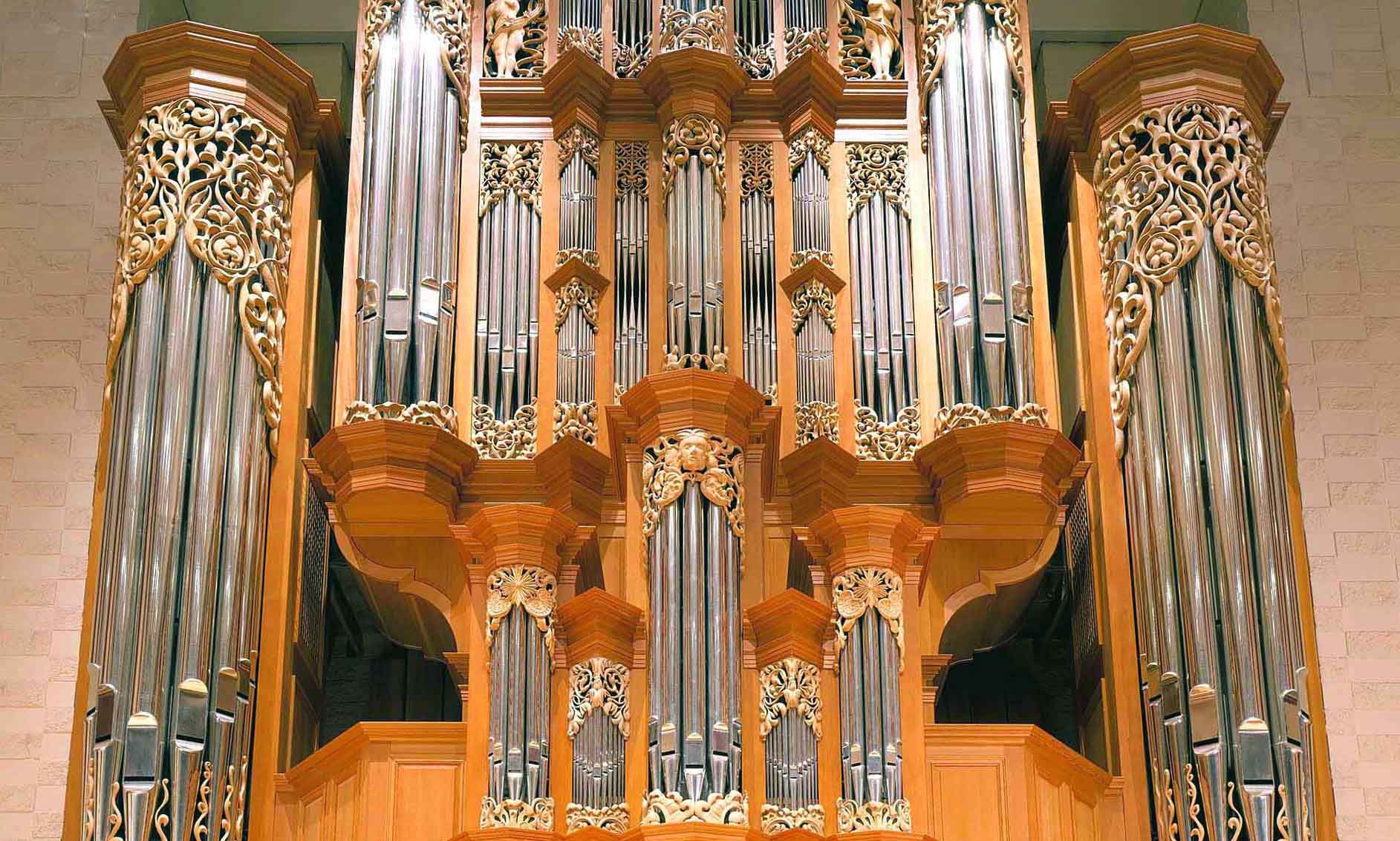
Symphonietta consists of three movements and is inspired by the wealth of magnificent church and concert organs in the world.
The work of Charles Widor, who with his marvellous organ symphonies has enthralled countless listeners, was an extra source of inspiration, whilst not wishing to imitate him. The atmosphere of this work is reminiscent of a large cathedral or church in which these types of works are usually played.
It begins with a sort of conversation between the different soloists and evolves into a beautiful melody. The sacred atmosphere in the 2nd theme forms the foundation for the rest of the work.
The playful 2nd movement, in which there are further variations on the themes, provides a good contrast to this.
In the 3rd movement the conversation returns, following which there is a build-up to the largest climax. The listener is thus left with an impressive image of a splendid organ.
Il Racconto del Re Pazzo is based on the story “The Wicked Prince” by Hans Christian Andersen.
The music follows the general drift of the story. The Prince is represented by a melody which is characterized by the suggestion of a large range. The heroic character as well as the atrocities are portrayed by the virtuoso allegro.
The abrupt breaking off of the fugue-like foundation symbolizes the total shock resulting from the announcement that the prince wants to attack God.
The priests, who try to prevent the Prince from attacking God, are presented through a more plaintive melody. The priests confer with each other about their tactics in the form of a fugue.
However they do not get enough time for this as the Prince abruptly attacks with his wondrous ship. Then God appears and opens the Gates of Heaven for the angels by means of a beautifully sounding G Major chord. The Angel descends (piccolo/flute and clarinet) and lets the single drop of blood fall (glockenspiel). Then follows the dizzying decline of the ship (without the cliché of letting it fall to the accompaniment of loud crashing noises).
The Prince is deeply affected but is more militant than ever. War fanfares announce the start of the 2nd battle (offstage trumpets) accompanied by the pleas of the priests begging him not to go ahead with it. The battle is represented by a buildup of an “armada” which becomes increasingly faster.
A swarm of gnats emerges out of nowhere, one of which (piccolo) manages to sting the Prince. The Prince screams loudly (high woodwinds, trumpets and trombones), after which the main theme returns but now in a mocking tone.
The allegro now returns but this time in a minor key. The work ends with the death of the Prince – God calls him – in the form of a quickly rising swarm, shortly after which the piece ends.
Recording byFanfare Eensgezindheid Maasbracht-Beek – conducted by Jean-Pierre Cnoops
Den onde Fyrste is based on the story “The Wicked Prince” by Hans Christian Andersen.
The music follows the general drift of the story. The Prince is represented by a melody which is characterized by the suggestion of a large range. The heroic character as well as the atrocities are portrayed by the virtuoso allegro.
The abrupt breaking off of the fugue-like foundation symbolizes the total shock resulting from the announcement that the prince wants to attack God.
The priests, who try to prevent the Prince from attacking God, are presented through a more plaintive melody. The priests confer with each other about their tactics in the form of a fugue.
However they do not get enough time for this as the Prince abruptly attacks with his wondrous ship. Then God appears and opens the Gates of Heaven for the angels by means of a beautifully sounding G Major chord. The Angel descends (saxophones) and lets the single drop of blood fall (glockenspiel). Then follows the dizzying decline of the ship (without the cliché of letting it fall to the accompaniment of loud crashing noises).
The Prince is deeply affected but is more militant than ever. War fanfares announce the start of the 2nd battle (offstage trumpets) accompanied by the pleas of the priests begging him not to go ahead with it. The battle is represented by a buildup of an “armada” which becomes increasingly faster.
A swarm of gnats emerges out of nowhere, one of which (soprano saxophone) manages to sting the Prince. The Prince screams loudly (trumpets and trombones), after which the main theme returns but now in a mocking tone.
The allegro now returns but this time in a minor key. The work ends with the death of the Prince – God calls him – in the form of a quickly rising swarm, shortly after which the piece ends.
Appassionato, an overture for Fanfare Band was composed in 2006 based on the musical term ”Apassionato”, which can mean passionate, fervent, obsessed, heated, fanatic, rousing, hot-blooded, intense, infatuated, diligent, profound, stormy, enraptured, ardent, fiery, warm-blooded, sultry, warm, high-spirited, excited, inflammable, tempestuous, furious, vivid, enthusiastic and inspired.
The main theme is based on a number of the above definitions: passionate and enthusiastic. The work commences without an introduction with the main theme being played by the horn section. The listener is, as it were, directly “passionately” carried along in the stream of the music.
The second theme is based on a postcard with the text “I am at rest, whilst dancing passionately”. The theme has the character of a dance and gradually becomes integrated with the main theme. By this means there is a fiery interaction between the two themes which leads into the third theme.
This third theme is based on the adage: “Cursed passion, come murder me with your rage, but do not kill me with your sneaking poison”. The theme creeps to the climax to result in a fiery coda, in which the main theme is “murdered” slowly.
Recording: (live) by Fanfare “Brass-aux-Saxes” Westerlo (B) – conducted by Jan van Hove.
Rubato was composed with the aim of creating a work which would bring a surprise to both musicians and audiences each time it was performed.
The musical term “rubato” or “tempo rubato” proved very suitable for this. The Italian term “tempo rubato” literally means stolen time. In performance it is the practice of altering the relationship between written note-values and making the pulse flexible by accelerating and slowing down the tempo. The fact that there are more types of rubato creates an enormous potential for different performances as long as the musical logic is respected.
Rubato is a challenging work full of artistic tension. There is a solo-like introduction. Four saxophone soloists have to try to ensure that one saxophone comes into being with one opinion as to the chosen tempo rubato.
After the introduction the flugelhorn initially plays the main theme which continually transforms during the piece. Different soloists take over from the flugelhorn which results in a majestic repetition of the original theme.
Recording: (live) by Fanfare “Brass-aux-Saxes” Westerlo (B) – conducted by Jan van Hove.

 Suite No. 5 / Digital Set€ 50,00 excl. VAT